
- By admin
- October 15, 2026
- 0 Comment
How Much Should a Transformer Gasket Actually Be Compressed?
“The gasket is leaking. Tighten the bolts a little more.”
It sounds logical. And sometimes, it may temporarily reduce the leakage.
But when it comes to transformer gasket compression, more pressure does not always mean better sealing.
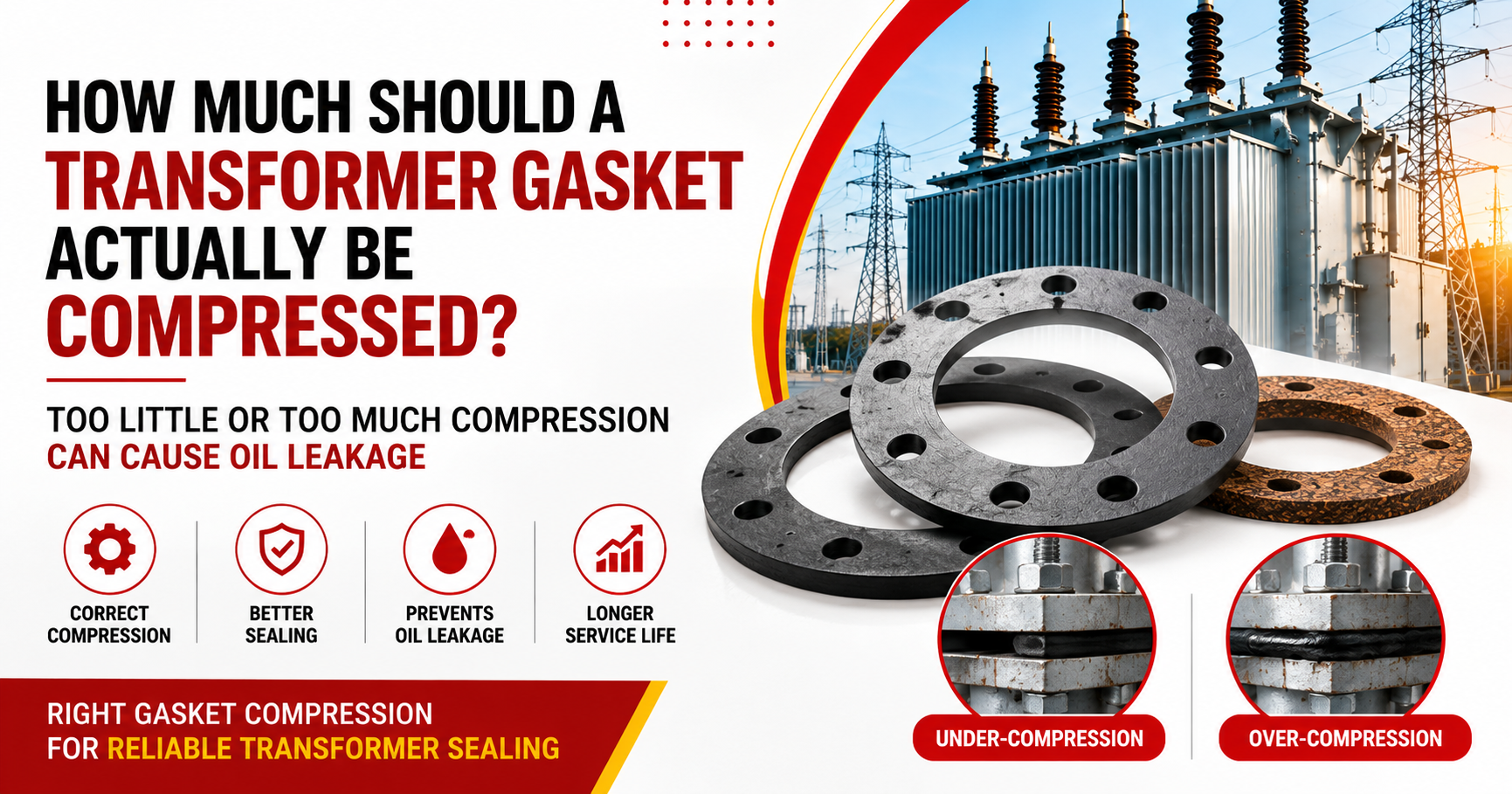
Both under-compression and over-compression can affect gasket performance, potentially leading to transformer oil leakage, deformation and reduced sealing reliability.
Whether you are using a solid NBR gasket or an NBR-bonded rubberised cork gasket, understanding the correct compression requirements is essential for selecting, installing and maintaining transformer gaskets.
So, how much should a transformer gasket actually be compressed?
The answer depends on the gasket material, thickness, hardness, flange design, joint geometry and manufacturer’s recommendations. There is no single compression percentage suitable for every transformer gasket application.
Why Is Transformer Gasket Compression Important?
However, the gasket must also retain its ability to maintain the seal under operating conditions.
Correct transformer gasket compression helps support:
- Effective sealing between mating surfaces
- Reduced risk of transformer oil leakage
- Consistent contact pressure across the joint
- Reliable performance during temperature changes
- Long-term gasket stability
The objective is not to compress the gasket as much as possible. It is to achieve the compression intended for the specific gasket and joint design.
For a broader understanding of gasket behaviour, read our guide on how gaskets work in an electrical transformer.
What Happens When a Transformer Gasket Is Under-Compressed?
A gasket needs sufficient compression to conform to the mating surfaces and create an effective seal.
When an NBR gasket is under-compressed, it may not establish adequate contact across the sealing area. Small surface irregularities can remain unsealed, creating potential leakage paths.
Possible consequences include:
- Transformer oil sweating around the flange
- Oil leakage at specific points along the joint
- Inconsistent sealing contact
- Leakage that becomes noticeable during operating temperature changes
How Does Flange Design Affect Gasket Compression?
Solid NBR Gaskets in Grooved Flanges
Because solid rubber tends to move laterally when compressed, a properly designed groove can help control the gasket’s position and deformation.
However, successful sealing still depends on factors such as:- Gasket thickness and hardness
- Groove width and depth
- Available space for deformation
- Flange dimensions
- Installation procedure
NBR-Bonded Rubberised Cork Gaskets on Flat Flanges
Rubberised cork is a composite material made from cork granules bonded with an elastomeric binder, commonly NBR-based.
The cork structure gives the material different compression characteristics from solid NBR. Suitable rubberised cork grades can conform to minor surface irregularities while limiting excessive lateral flow.
This makes rubberised cork a common option for suitable flat-flange applications, including transformer covers and other sealing joints.
However, rubberised cork also has compression limits. Excessive tightening can crush the material beyond its intended working range and affect its sealing performance.
For more detail, read our article on Flat Flange vs. Gasket Groove: Why Flange Design Can Decide Your Gasket Material.
NBR Gasket vs. Rubberised Cork Gasket: Which Handles Compression Better?
Solid NBR and NBR-bonded rubberised cork behave differently under compression because their structures and mechanical properties are different.
Solid NBR provides a relatively uniform rubber structure and can maintain dimensional stability in appropriately designed sealing arrangements.
Rubberised cork offers greater compressibility in suitable grades and can accommodate minor surface irregularities in certain flat-flange applications.
| Factor | Solid NBR Gasket | Rubberised Cork Gasket |
|---|---|---|
| Material Structure | Solid elastomer | Cork granules with an elastomeric binder |
| Compression Behaviour | Elastic deformation of solid rubber | Compression of the composite structure |
| Typical Joint Consideration | Often suitable for designed grooves | Often suitable for flat flanges |
| Main Selection Factors | Hardness, thickness, groove and joint design | Grade, thickness, flange condition and compression |
| Over-Compression Risk | Deformation and excessive lateral movement | Excessive crushing and reduced sealing performance |
Read our detailed comparison: NBR Gasket vs. Rubber Cork Gasket for Transformers: Which One Should You Choose?
Is There a Standard Compression Percentage for Transformer Gaskets?
There is no universal compression percentage that should be applied to every transformer gasket.
The appropriate compression depends on several application-specific factors:- Gasket material and compound formulation
- Material hardness
- Original gasket thickness
- Required compressed thickness
- Flange or groove geometry
- Bolt arrangement and joint stiffness
- Operating temperature
- Manufacturer’s technical specifications
How Can You Control Transformer Gasket Compression?
Confirm the Gasket Specification
Check the material, hardness, thickness, dimensions and profile against the required drawing.
Follow the Approved Tightening Sequence
Tighten bolts in the specified sequence and use the appropriate torque or bolt-loading requirements for the joint.
Inspect the Flange Surfaces
Look for corrosion, scratches, contamination, old gasket residue and flange distortion.
Check the Joint Design
Confirm whether the gasket is intended for a flat flange, grooved flange or another sealing arrangement.
Avoid Uncontrolled Over-Tightening
If leakage continues, investigate the root cause rather than repeatedly increasing bolt torque.
Inspect the Completed Joint
Check the sealing area after installation and follow the applicable inspection and maintenance procedure.
These steps help address the complete sealing system rather than treating every leakage problem as a gasket-material failure.
Frequently Asked Questions (FAQs)
1. How much should an NBR transformer gasket be compressed?
There is no single percentage suitable for every NBR gasket. The correct compression depends on the compound, hardness, thickness, joint design and manufacturer’s specifications.
2. Can over-tightening cause transformer oil leakage?
Yes. Excessive tightening can deform a gasket or cause it to move out of its intended sealing position. If leakage occurs, inspect the joint and identify the underlying cause rather than automatically increasing bolt torque.
3. Is rubberised cork more compressible than solid NBR?
Rubberised cork is generally more compressible than solid NBR because of its composite cork-and-elastomer structure. Actual performance depends on the material grade, formulation and thickness.
4. Why are rubberised cork gaskets used on flat transformer flanges?
Suitable rubberised cork grades can conform to minor surface irregularities while limiting lateral movement during compression. This makes them useful for many flat-flange sealing applications.
5. What should I check if a transformer gasket leaks after installation?
Check gasket dimensions, material compatibility, flange condition, joint geometry, bolt tightening and compression. A suitable gasket may still leak if the surrounding sealing system is not correct.
Conclusion
Transformer gasket compression is about achieving the right sealing pressure, not applying the maximum possible force.
Before installing or replacing a transformer gasket, verify its specifications, inspect the sealing surfaces and follow the approved tightening procedure. These checks can help reduce repeated transformer oil leakage and improve sealing reliability.
For more detailed information on transformer gaskets, gasket selection and sealing applications, visit our book website, www.transformergaskets.in, to get your copy.
To learn more about our transformer gasket products and industrial sealing solutions, visit Pristine Technologies & Industries.