
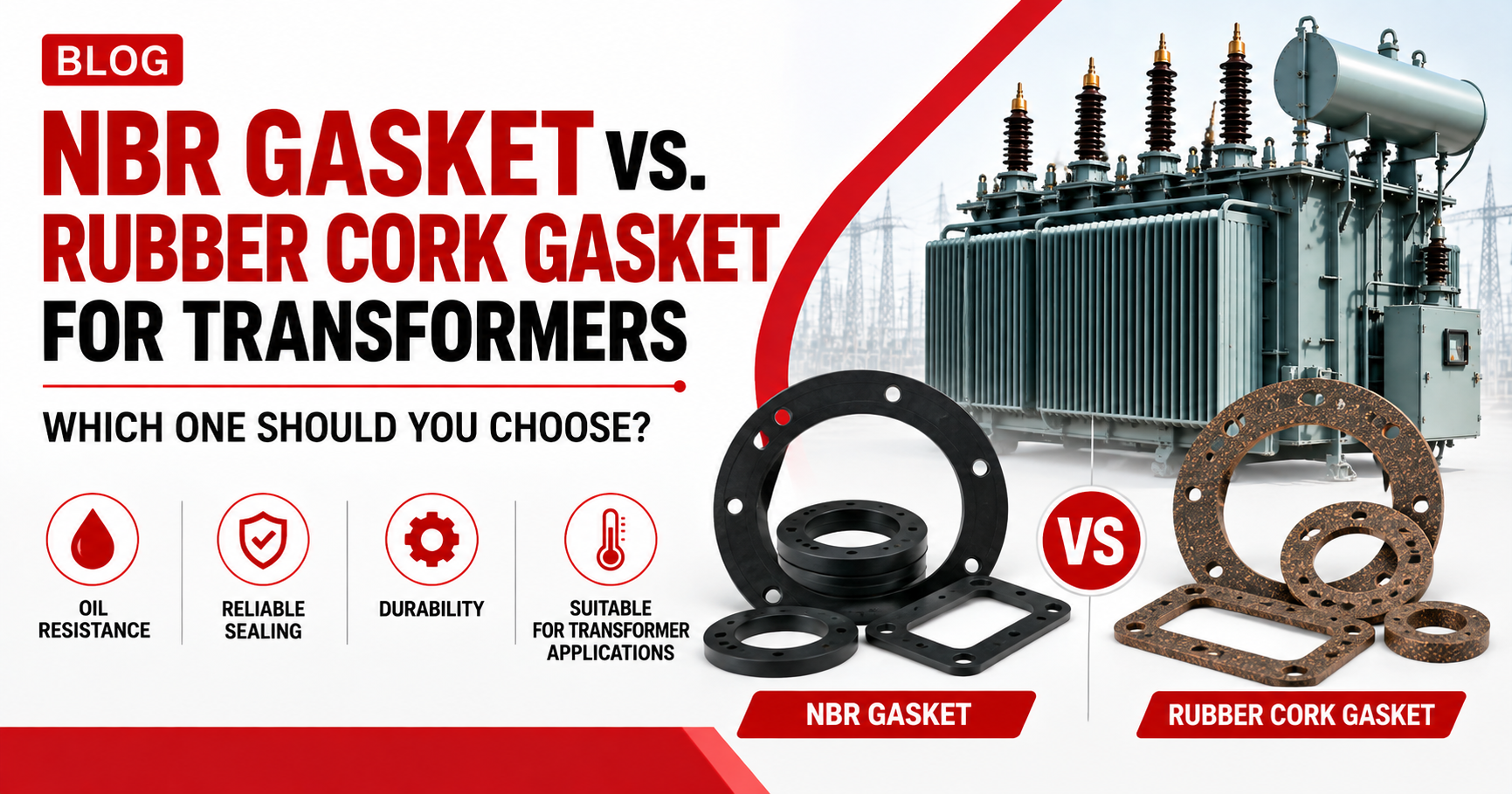
NBR Gasket vs. Rubber Cork Gasket for Transformers: Which One Should You Choose?
If you’re specifying a transformer gasket for a tank cover, radiator flange, or bushing joint, you’ll almost always be choosing between two material families: NBR (nitrile rubber) and rubberised cork. Both are proven, both are used across power and distribution transformers worldwide and both can deliver a 100% leakproof seal, but they’re not interchangeable. Picking the wrong one for a given flange doesn’t usually fail immediately; it fails quietly, months or years later, as a slow oil weep that’s expensive to trace and worse to explain to a client.
This guide breaks down how NBR gaskets and rubber cork gaskets actually differ, where each one performs best and how to make the right call for your specific transformer application.
A Quick Recap: What Each Material Is
A NBR gasket, sometimes called a nitrile rubber gasket, is a solid synthetic rubber gasket compounded specifically for oil resistance. NBR (nitrile butadiene rubber) is prized in transformer applications because it doesn’t swell, soften, or degrade on prolonged contact with mineral transformer oil the way many general-purpose elastomers do.
A rubber cork gasket, also called a rubberized cork gasket, is a composite material: natural cork granules bonded together with a rubber binder (commonly NBR or a similar oil-resistant rubber) and compressed into sheet form. The cork gives it a very different mechanical character from solid rubber, even though the binder itself may be chemically similar to a pure NBR gasket.
That last point matters. The real difference between these two products isn’t oil resistance alone, since both handle transformer oil well. It’s how each material behaves mechanically under compression.
Oil Resistance
Both materials are formulated for transformer oil service, so oil resistance alone rarely decides the choice. NBR, as a solid homogeneous rubber, tends to have a slight edge in long-term chemical stability and resistance to oil-related swelling, particularly at higher operating temperatures. Rubberised cork, with correctly selected binder rubber, still performs well, which is why it remains the standard choice across large sections of the transformer industry, but overall performance depends more heavily on getting the binder-to-cork ratio and compound quality right.
Practical takeaway: for high-temperature zones or joints with sustained direct oil pressure, NBR is usually the safer default. For general tank and cover joints with moderate oil exposure, rubberised cork’s track record is well established.
Compressibility and Sealing on Uneven Surfaces
This is where the two materials genuinely diverge. Rubberised cork is significantly more compressible than solid NBR rubber. That compressibility lets it conform to surface irregularities, such as a lightly warped cast flange or an unevenly machined cover and still achieve a tight seal without needing excessive bolt torque.
NBR gaskets, being a denser, more uniform rubber, don’t compress the same way. On precision-machined, flat flange surfaces, that’s an advantage: NBR holds its shape and dimensional accuracy under load, giving a consistent, predictable seal. On uneven or cast surfaces, though, a solid NBR gasket can struggle to seat fully, leaving micro-gaps that eventually become leak paths.
Practical takeaway: rubberised cork gaskets are generally the better choice for cast tank surfaces and less precisely machined joints. NBR gaskets are generally the better choice for precision-machined flanges and higher-pressure sealing points.
Mechanical Strength and Long-Term Dimensional Stability
NBR gaskets tend to hold their compressed thickness and shape more consistently over long service periods, which matters for joints that are rarely re-torqued after commissioning. Rubberised cork, while durable, can experience slightly more compression set over very long timeframes if the compound and cure quality aren’t tightly controlled, which is exactly why compound consistency and manufacturing process matter as much as the raw material choice itself. This is also why sourcing from a manufacturer with in-house testing, rather than a generic trader, matters for either material.
Cost and Availability
Rubberised cork gaskets are generally more cost-effective at scale, particularly for larger tank-cover-sized cuts, since cork content reduces the amount of pure rubber compound required. NBR gaskets, being solid rubber, typically cost more per equivalent area but can offer better long-term value on critical, hard-to-access joints where a repeat failure is far more expensive than the material cost difference.
NBR vs. Rubber Cork Gasket: Side-by-Side Summary
| Factor | NBR Gasket | Rubber Cork Gasket |
|---|---|---|
| Oil resistance | Excellent, very stable at high temperature | Good to excellent (binder-dependent) |
| Compressibility on uneven flanges | Moderate | Excellent |
| Dimensional stability over decades | Very good | Good, compound-dependent |
| Best-fit joint type | Precision-machined, high-pressure | Cast or less-precisely-machined |
| Typical relative cost | Higher | More economical at scale |
How to Decide for Your Transformer
In practice, most transformer manufacturers don’t standardize on one material across the whole unit. They specify NBR gaskets for the most critical, highest-pressure, precision-machined joints (like bushing turrets and certain valve connections) and rubberised cork gaskets for tank covers, manhole covers and radiator flanges where the surface is less uniform and the cost-per-unit-area matters more at scale. If you’re unsure which fits your specific drawing, the fastest way to get it right is to have your flange type, surface finish and operating temperature reviewed directly rather than guessing from general rules of thumb.
FAQ’s
Can I use a rubber cork gasket anywhere an NBR gasket is specified, or vice versa?
Not automatically. While both are used across transformer applications, swapping materials on a joint designed around a specific gasket’s compressibility and thickness can change the sealing performance. Always confirm against the original specification or consult the manufacturer before substituting.
Which material is better for extreme temperature or extreme weather regions?
NBR’s greater dimensional stability at temperature extremes generally makes it the preferred choice for regions with very high ambient temperatures or wide seasonal swings, though correctly compounded rubberised cork also performs reliably across a broad temperature range. See our related post on gaskets for extreme weather conditions for more detail.
Is a transformer oil resistant gasket the same thing as an NBR gasket?
“Transformer oil resistant gasket” is a functional description that both NBR and correctly formulated rubberised cork gaskets satisfy. It’s not synonymous with NBR alone. The right oil-resistant material still depends on your specific joint and operating conditions, as outlined above.
Do you manufacture both NBR and rubber cork gaskets to custom specifications?
Yes. Pristine Technologies manufactures both NBR gaskets and rubber cork gaskets to customer drawings and our team can help you determine the right material for a specific joint. See our full transformer gasket range or contact us with your flange specifications.
Still not sure which transformer gasket material is right for your application? Contact our team with your flange drawing and operating conditions, or try GasketAdvisor AI for an instant material recommendation.