
- By admin
- November 9, 2026
- 0 Comment
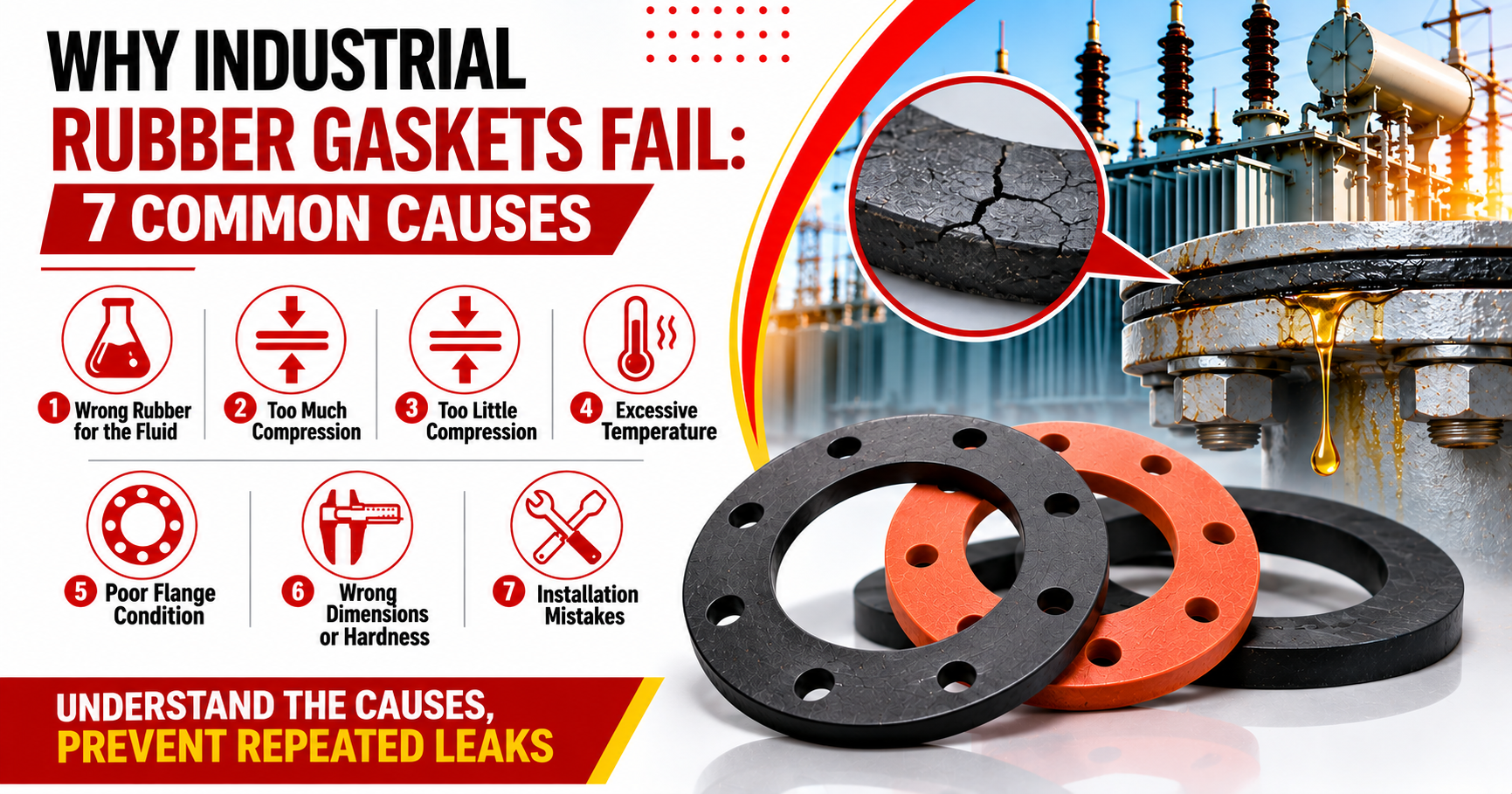
Industrial Rubber Gasket Failure: 7 Common Causes
“We need an oil-resistant gasket for this transformer.”
Sounds like a complete specification. But it really isn’t.
A Transformer Oil Resistant Gasket can be labelled oil-resistant and still be unsuitable for a particular transformer joint. The correct choice depends on the insulating fluid, operating temperature, flange design, compression requirements and material test data.
Whether you are selecting an NBR gasket or an NBR-bonded rubberised cork gasket, these six factors can help you make a more informed decision.
Incorrect Rubber Material for the Fluid
ot all rubber materials offer the same chemical resistance.
NBR, EPDM, Neoprene and Silicone have different properties and are designed for different operating environments.
For example:
- NBR: Commonly selected for petroleum-based oil applications.
- EPDM: Offers excellent resistance to weathering, ozone and water, but is generally unsuitable for petroleum-based mineral oils.
- Neoprene: Provides a balance of mechanical properties and resistance to certain oils and environmental conditions.
- Silicone: Known for broad temperature flexibility, although oil compatibility depends on the specific formulation.
How to prevent it: Check the gasket material against the actual fluid, operating temperature and exposure conditions before specifying it.
Explore our NBR Rubber Sheets to learn more about NBR material and its industrial applications.
Excessive Gasket Compression
When a gasket leaks, one common reaction is to tighten the bolts further.
However, excessive tightening can make the problem worse.
Over-compression may cause:
- Permanent gasket deformation.
- Material damage or crushing.
- Gasket extrusion from the joint.
- Reduced ability to maintain sealing force.
- Premature gasket deterioration.
How to prevent it: Follow the recommended tightening sequence and compression requirements. Do not assume that applying more bolt torque will always improve sealing.
Read our guide: How Much Should a Transformer Gasket Actually Be Compressed?.
Insufficient Gasket Compression
Too little compression can be just as problematic as excessive compression.
When a gasket is not compressed sufficiently, it may fail to make consistent contact with the mating surfaces. This can leave small leakage paths through which oil, water or other fluids can escape.
Insufficient compression may result from:
- Incorrect bolt tightening.
- Unsuitable gasket thickness.
- Incorrect gasket hardness or compressibility.
- Uneven flange surfaces.
- Incorrect gasket dimensions.
How to prevent it: Select the correct gasket thickness and material properties and ensure that the joint provides sufficient and uniform compression.
Excessive Operating Temperature
Temperature plays an important role in industrial rubber gasket performance.
When a gasket operates beyond the capability of its material compound, it may experience accelerated ageing and changes in physical properties.
Common signs include:
- Hardening or loss of flexibility.
- Softening or material deterioration.
- Surface cracking.
- Reduced elasticity.
- Loss of sealing performance.
Temperature and fluid compatibility should always be evaluated together. A rubber material that performs well at one temperature may behave differently under prolonged exposure to higher temperatures.
How to prevent it: Check the minimum and maximum operating temperatures and select a suitable rubber compound for the actual service conditions.
Poor Flange Surface Condition
Damaged or uneven mating surfaces can prevent consistent sealing contact.
Common flange-related problems include:
- Corrosion and rust.
- Scratches and surface damage.
- Flange distortion.
- Uneven mating surfaces.
- Paint or coating irregularities.
- Old gasket residue.
How to prevent it: Inspect and clean the mating surfaces before installation. Check flange flatness, surface condition and alignment according to the joint requirements.
For more information, read Flat Flange vs. Gasket Groove for Transformer Gaskets.
Incorrect Gasket Dimensions or Hardness
A gasket that is almost the correct size is not necessarily suitable for the application.
Dimensions and material properties directly influence how a gasket behaves when compressed.
Important factors include:
- Gasket thickness.
- Inner and outer diameter.
- Width and profile.
- Bolt-hole positioning.
- Material hardness.
- Compressibility and recovery.
For applications requiring different sealing materials, compare NBR Gasket vs. Rubber Cork Gasket for Transformers.
Improper Gasket Installation
Sometimes, gasket failure begins before the equipment even enters service.
Incorrect installation can damage a perfectly suitable gasket or prevent it from sealing properly.
Common installation mistakes include:
- Uneven bolt tightening.
- Incorrect gasket alignment.
- Installing the gasket on dirty surfaces.
- Stretching or twisting the gasket during assembly.
- Reusing a damaged or unsuitable gasket.
- Ignoring the recommended installation procedure.
These mistakes can create uneven pressure distribution and potential leakage paths.
How to prevent it: Clean the mating surfaces, position the gasket correctly and follow the recommended tightening sequence and installation instructions.
Read more about How Do Gaskets Work in an Electrical Transformer?.
How to Identify the Root Cause of Industrial Rubber Gasket Failure
Replacing a failed gasket without identifying the underlying problem may result in repeated leakage.
Before installing a replacement, consider this checklist:
Material: Is the rubber compound compatible with the fluid?
Temperature: Is the material suitable for the operating temperature?
Compression: Was the gasket compressed correctly?
Flange: Are the mating surfaces clean, flat and undamaged?
Dimensions: Are the gasket thickness, profile and dimensions correct?
Installation: Was the gasket installed according to the recommended procedure?
Inspection: Does the failed gasket show swelling, cracking, extrusion, hardening or other signs of deterioration?
Choosing the Right Industrial Rubber Gasket Manufacturer
Selecting the right manufacturer is an important step in reducing the risk of gasket-related problems.
When evaluating an industrial rubber gasket manufacturer, consider:
- Availability of suitable rubber material grades.
- Consistent product quality.
- Accurate dimensions and manufacturing tolerances.
- Customised gasket manufacturing capabilities.
- Material specifications and relevant test data.
- Technical support for application-specific requirements.
Explore our Rubber Sheets and Gaskets and complete product range to learn more about available products.
Frequently Asked Questions (FAQs)
1. What are the common causes of industrial rubber gasket failure?
Common causes include incorrect material selection, excessive compression, insufficient compression, high operating temperatures, poor flange conditions, incorrect dimensions and improper installation.
2. Why do rubber gaskets leak?
Rubber gaskets may leak because of fluid incompatibility, incorrect compression, damaged mating surfaces, unsuitable gasket dimensions or installation errors.
3. Can excessive compression damage a rubber gasket?Can excessive compression damage a rubber gasket?
Yes. Excessive compression can cause permanent deformation, crushing, extrusion or other material damage, potentially affecting sealing performance.
4. Which rubber is best for industrial gaskets?
The correct material depends on the fluid, operating temperature and environmental conditions. NBR is commonly selected for petroleum-oil applications, EPDM for weather and water resistance, Neoprene for certain general industrial applications and Silicone for broad temperature flexibility.
5. How can industrial rubber gasket failure be prevented?
Choose a compatible material, verify gasket dimensions, control compression, inspect flange surfaces and follow the correct installation procedure.
Conclusion
Industrial rubber gasket failure is not always caused by poor-quality material. Incorrect material selection, excessive or insufficient compression, high temperatures, damaged flanges, incorrect dimensions and improper installation can all contribute to sealing problems.
The most effective way to prevent repeated gasket failure is to evaluate the complete sealing system rather than blaming the gasket alone.
Remember:
Material + Fluid + Temperature + Flange + Compression + Installation = Reliable Sealing Performance