
- By admin
- October 26, 2026
- 0 Comment
Does NBR Swell in Transformer Oil? When Swelling Is Normal—and When It Becomes a Problem
NBR (Nitrile Butadiene Rubber) is commonly selected for sealing applications where resistance to oil is important. In electrical transformers, NBR-based gaskets may be exposed to transformer oil for extended periods. However, oil exposure can affect the dimensions, hardness and sealing performance of rubber materials.
Understanding NBR swelling in transformer oil helps transformer manufacturers, maintenance teams and component buyers choose suitable gasket materials and identify potential sealing problems.
What Is NBR and Why Is It Used in Transformer Gaskets?
NBR is a synthetic rubber known for its resistance to oils and certain petroleum-based fluids. Its performance depends on the rubber formulation, acrylonitrile content, curing system, operating temperature and the type of oil it contacts.
In transformer applications, NBR-based materials may be used for sealing joints, covers and other components where oil leakage must be controlled. Selecting the right compound is essential because not every NBR formulation performs identically under transformer operating conditions.
Learn more about NBR Rubber Sheets and their potential applications.
Does NBR Swell in Transformer Oil?
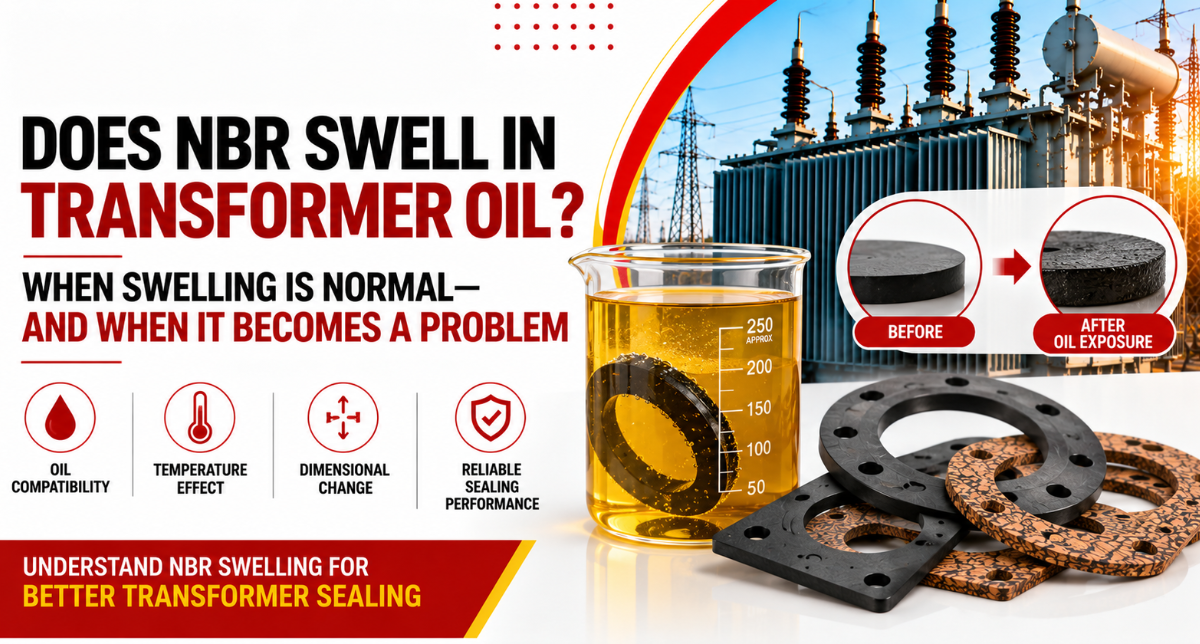
Yes, NBR can swell when exposed to transformer oil. The amount of swelling depends on the rubber compound, oil composition, temperature and duration of exposure.
Swelling occurs when compatible or partially compatible oil components enter the rubber material and cause it to increase in volume. Some dimensional change may occur during exposure, but excessive swelling can affect the gasket’s fit and sealing performance.
There is no single swelling limit that should automatically be applied to every NBR gasket. Acceptable changes should be assessed against the material specification, applicable test method and requirements of the particular transformer application.
What Factors Affect NBR Gasket Swelling?
Rubber Compound Formulation
Different NBR compounds can behave differently when exposed to the same oil. The formulation, including acrylonitrile content and other ingredients, influences oil resistance and physical properties.
Transformer Oil Composition
Transformer oils can differ in their composition and characteristics. Compatibility should therefore be evaluated using the actual oil or an appropriate representative fluid under the specified test conditions.
Operating Temperature
Higher temperatures can change the rate at which oil interacts with a rubber material. Long-term exposure at elevated temperatures may also affect hardness, elasticity and other properties.
Duration of Oil Exposure
A gasket exposed to oil for a short period may behave differently from one that remains immersed or continuously exposed over a longer period. Testing should reflect the intended service conditions as closely as practical.
Gasket Design and Compression
Even when a material has suitable oil resistance, incorrect gasket dimensions, uneven compression or an unsuitable flange surface can contribute to leakage.
For additional guidance, read How Do Gaskets Work in an Electrical Transformer?.
When Is NBR Swelling a Problem?
- Excessive dimensional changes that affect gasket installation.
- Softening, hardening, cracking or other visible material deterioration.
- Distortion or displacement from the intended sealing position.
- Persistent oil leakage despite correct installation.
- Loss of elasticity or inadequate recovery after compression.
How Can Transformer Gasket Swelling Be Evaluated?
Check the material specification: Confirm the grade and compound requirements supplied by the manufacturer.
Review oil compatibility: Verify whether the selected material is suitable for the transformer oil being used.
Conduct appropriate testing: Measure changes in mass, volume, dimensions and hardness using a relevant test method and defined exposure conditions.
Inspect the gasket after exposure: Look for cracking, softening, distortion and other changes that may affect sealing.
Review installation conditions: Check compression, flange condition, gasket dimensions and tightening procedures.
Compare the material and application requirements before selecting a replacement. You can also read NBR Gasket vs. Rubber Cork Gasket for Transformers to understand how these material options differ.
NBR Gasket vs. Rubberised Cork Gasket for Transformers
NBR and rubberised cork are not identical materials. Solid NBR is a rubber compound, while rubberised cork is a composite material made using cork granules and a suitable rubber binder.
The right choice depends on factors such as sealing requirements, flange design, compression behaviour, oil compatibility, operating temperature and the material specifications of the application.
Neither material should be selected solely on the assumption that one will always swell less or provide better sealing. Evaluate the particular grade and its performance under the intended operating conditions.
Explore Rubberised Cork Sheets and Rubber Cork Gaskets for more information about these related sealing products.
Choosing an NBR Gasket Manufacturer in India
Transformer manufacturers and maintenance teams should work with a supplier that can clarify material specifications, intended applications and relevant testing requirements.
When evaluating an NBR Gasket manufacturer In India, consider the following factors:
- Availability of suitable NBR material grades.
- Clear product specifications and dimensional tolerances.
- Information about oil compatibility and operating conditions.
- Consistent manufacturing quality and inspection procedures.
- Technical support for selecting materials for the intended application.
Businesses searching for an NBR Gasket supplier In India should confirm that the supplied material meets their required specifications rather than relying on the product name alone.
For international procurement, an NBR Gasket exporter In India should be able to clarify product specifications, order requirements and relevant documentation for the destination market.
Frequently Asked Questions (FAQs)
1. Does NBR swell in transformer oil?
Yes. NBR may absorb components of transformer oil and increase in volume. The extent of swelling depends on the compound, oil type, temperature and exposure duration.
2. Is NBR suitable for transformer gaskets?
Some NBR compounds may be suitable for transformer sealing applications, but suitability must be verified against the oil, temperature, operating conditions and material specifications.
3. Does NBR swelling always cause oil leakage?
No. Swelling does not automatically cause leakage. Problems may arise if dimensional changes or material deterioration interfere with the gasket’s fit or sealing performance.
4. How can NBR gasket compatibility with transformer oil be checked?
Use a relevant material compatibility test under defined conditions. Depending on the applicable specification, evaluation may include changes in volume, mass, hardness and physical appearance.
5. How do I choose an NBR gasket supplier in India?
Check the supplier’s product specifications, material grade, quality-control procedures, available technical information and ability to meet the requirements of your transformer application.
Conclusion
NBR can swell when exposed to transformer oil, but the extent and significance of that change depend on the material formulation, oil characteristics, temperature and exposure duration. Excessive swelling may affect gasket dimensions and sealing performance, while minor dimensional changes do not automatically indicate failure.
Choosing the appropriate material, verifying oil compatibility, following suitable testing procedures and installing the gasket correctly can help reduce sealing problems in transformer applications.
For the best results, evaluate the actual gasket specification and service conditions before selecting a material for a transformer.