
- By admin
- October 21, 2026
- 0 Comment
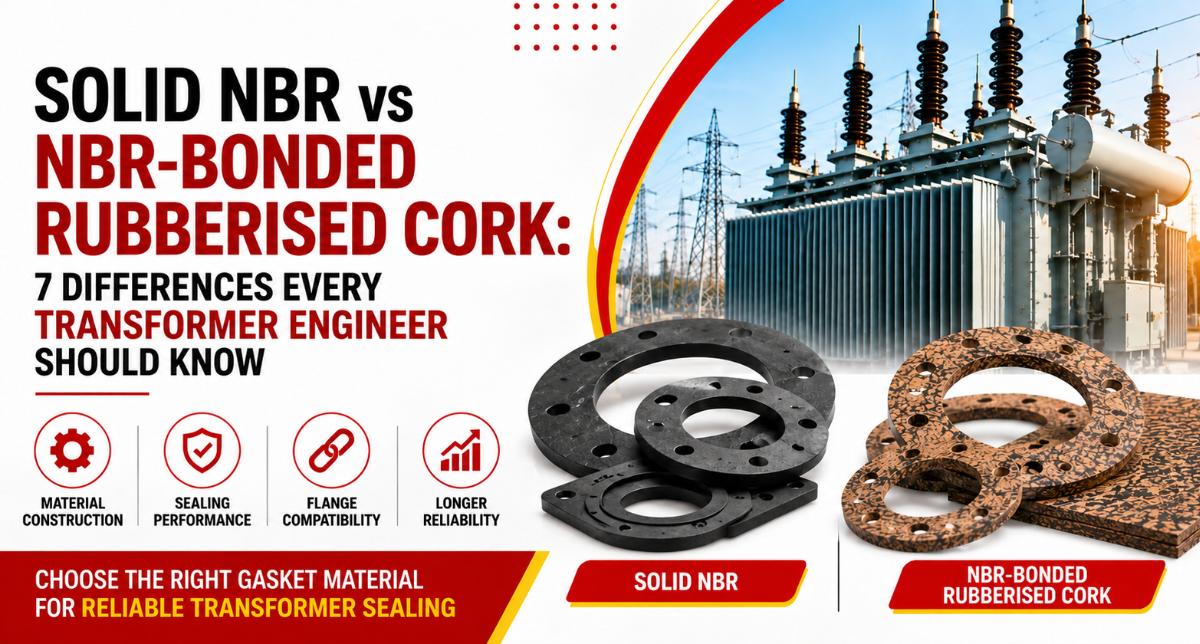
Solid NBR vs NBR-Bonded Rubberised Cork: 7 Differences Every Transformer Engineer Should Know
“Both contain NBR, so aren’t they basically the same?”
Not really.
Solid NBR and NBR-bonded rubberised cork gaskets are both used in sealing applications for oil-filled transformers. However, their construction, compression behaviour and suitability for different flange designs can vary significantly.
Choosing the wrong transformer gasket material can contribute to oil leakage, repeated maintenance, unnecessary gasket replacement and increased operating costs.
Understanding the differences between solid NBR and rubberised cork helps transformer manufacturers, maintenance engineers and purchasing teams make more informed decisions.
Here are seven practical differences every transformer engineer should know.
What Is the Difference Between Solid NBR and NBR-Bonded Rubberised Cork?
Solid NBR is a homogeneous nitrile rubber compound designed for sealing applications where oil resistance is important.
NBR-bonded rubberised cork is a composite material made from cork granules bonded together using an elastomeric binder, commonly NBR-based.
Although both materials may use NBR, their structures are different. Consequently, they do not respond identically to compression, flange irregularities or installation conditions.
The correct choice depends on the gasket specification, flange design, operating conditions and required sealing performance.
For a broader comparison, read our guide to NBR Gasket vs. Rubber Cork Gasket for Transformers: Which One Should You Choose?.
Construction: Solid Rubber vs. Cork-Rubber Composite
The first major difference is the material structure.
Solid NBR gasket: Manufactured from a homogeneous nitrile rubber compound. Its properties depend on the formulation, hardness and manufacturing process.
NBR-bonded rubberised cork gasket: Manufactured by combining cork granules with an elastomeric binder. The cork structure gives the material different compressibility and recovery characteristics.
This difference affects how each material behaves when the gasket is installed between mating surfaces.
Therefore, even when both materials are designed for transformer oil service, they should not automatically be treated as interchangeable.
Conformability: How Well Does the Gasket Adapt to Surface Irregularities?
Flange surfaces are not always perfectly uniform. Minor irregularities can affect the contact between a gasket and the mating surfaces.
Rubberised cork is generally more compressible than solid NBR and can conform well to minor surface irregularities in suitable applications.
Solid NBR relies on elastic deformation to establish the required sealing contact. Its performance depends on the compound properties, compression and joint geometry.
However, neither material should be used to compensate for severely damaged, distorted or improperly prepared flanges.
The practical lesson: Evaluate the flange condition before deciding which gasket material is appropriate.
Flange Design: Flat Flange vs. Grooved Flange
Flange design is one of the most important considerations when selecting a transformer gasket.
Solid NBR for suitable grooved applications
Solid NBR gaskets can be suitable for joints with a properly designed groove or recess that controls gasket positioning and accommodates deformation.
Examples may include certain grooved covers, bushing joints and O-ring-style sealing arrangements.
The groove dimensions must match the gasket specification.
NBR-bonded rubberised cork is widely used in suitable flat-flange applications, including transformer tank covers and other sealing joints.
Its composite structure helps limit lateral movement during compression while providing conformability.
The final choice should always follow the actual joint design rather than a general rule based only on material type.
Read our related guide: Flat Flange vs. Gasket Groove: Why Flange Design Can Decide Your Gasket Material.
Compression Behaviour: Why More Tightening Is Not Always Better
Both solid NBR and rubberised cork require appropriate compression to create an effective seal.
However, their responses to compression differ.
Solid NBR can deform laterally when compressed, particularly when the joint does not provide sufficient space or restraint.
Rubberised cork is compressible, but excessive crushing can damage its structure and affect its ability to maintain an effective seal.
Under-compression can also cause sealing problems because the gasket may not establish sufficient contact with the mating surfaces.
The correct compression depends on the gasket grade, thickness, joint geometry and manufacturer’s recommendations.
More bolt torque does not automatically mean better sealing.
For additional guidance, read How Much Should a Transformer Gasket Actually Be Compressed?
Hardness vs. Compressibility: Which Properties Matter?
For solid NBR, important specifications can include:
- Shore A hardness
- Tensile strength
- Elongation
- Compression set
- Oil compatibility
- Operating temperature range
For rubberised cork, engineers should also consider:
- Compressibility
- Recovery after compression
- Density
- Binder formulation
- Oil resistance
- Thickness and dimensional consistency
Total Cost: Why the Cheapest Gasket May Not Be the Best Choice
The initial purchase price is only one part of gasket selection.
An unsuitable gasket can contribute to oil leakage, repeated maintenance, labour costs, production interruptions and additional replacement expenses.
For transformer manufacturers and maintenance teams, the more useful comparison is the total cost of achieving reliable sealing over the expected service life.
Consider the following before making a purchasing decision:
- Suitability for the flange design
- Material compatibility with transformer oil
- Required compression and recovery
- Dimensional accuracy
- Product consistency
- Expected operating conditions
- Maintenance and replacement requirements
Solid NBR vs. NBR-Bonded Rubberised Cork: Comparison Table
| Parameter | Solid NBR Gasket | NBR-Bonded Rubberised Cork Gasket |
|---|---|---|
| Construction | Homogeneous nitrile rubber | Cork granules with an elastomeric binder |
| Conformability | Depends on compound and joint design | Generally more compressible |
| Compression Behaviour | Elastic deformation of solid rubber | Compression of a composite structure |
| Flange Suitability | Often suitable for designed grooves | Often suitable for flat flanges |
| Key Specifications | Hardness, thickness, compression set | Compressibility, recovery, density and thickness |
| Surface Irregularities | Requires appropriate contact and compression | Can accommodate minor irregularities in suitable applications |
| Selection Priority | Compound and joint compatibility | Grade and flat-flange compatibility |
Which Is Better: Solid NBR or Rubberised Cork?
That depends on the application.
Solid NBR can be an appropriate choice for a suitably designed groove or sealing arrangement where the rubber compound and joint geometry meet the operating requirements.
NBR-bonded rubberised cork can be an appropriate choice for many flat-flange applications where compressibility and limited lateral movement are important.
Neither material is universally better.
The correct selection should consider flange design, gasket dimensions, transformer oil compatibility, operating temperature, compression requirements and expected service life.
For a detailed discussion of material selection, explore our article on NBR Gasket vs. Rubber Cork Gasket for Transformers.
Follow the Approved Tightening Sequence
Tighten bolts in the specified sequence and use the appropriate torque or bolt-loading requirements for the joint.
Inspect the Flange Surfaces
Look for corrosion, scratches, contamination, old gasket residue and flange distortion.
Check the Joint Design
Confirm whether the gasket is intended for a flat flange, grooved flange or another sealing arrangement.
Avoid Uncontrolled Over-Tightening
If leakage continues, investigate the root cause rather than repeatedly increasing bolt torque.
Inspect the Completed Joint
Check the sealing area after installation and follow the applicable inspection and maintenance procedure.
These steps help address the complete sealing system rather than treating every leakage problem as a gasket-material failure.
Frequently Asked Questions (FAQs)
1. Is solid NBR the same as NBR-bonded rubberised cork?
No. Solid NBR is a homogeneous nitrile rubber compound, whereas rubberised cork combines cork granules with an elastomeric binder, commonly NBR-based. Their compression characteristics and applications can differ.
2. Which gasket is better for a flat transformer flange?
Rubberised cork is commonly used for suitable flat-flange transformer applications because of its compressibility and limited lateral movement. The final selection depends on the flange condition, gasket grade and operating requirements.
3. Can solid NBR gaskets be used in transformer grooves?
Yes. Solid NBR can be suitable for properly designed grooves and recesses that accommodate the gasket and control its deformation. The gasket dimensions and groove geometry must be compatible.
4. Does rubberised cork provide better sealing than solid NBR?
Not in every situation. Rubberised cork may be advantageous for certain flat-flange applications, while solid NBR may be appropriate for designed grooved joints. Sealing performance depends on material selection, joint design and installation.
5. Can over-tightening damage transformer gaskets?
Yes. Excessive compression can deform solid NBR or excessively crush rubberised cork. Always follow the specified tightening procedure and the gasket manufacturer’s recommendations.
Conclusion
Choosing between solid NBR and NBR-bonded rubberised cork gaskets is not simply a question of which material is better. It is about understanding how each material behaves under compression and how well it matches the transformer joint.
Solid NBR can be suitable for appropriately designed grooved sealing arrangements, while rubberised cork is widely used for suitable flat-flange applications. Construction, conformability, compression behaviour, material properties, surface condition and lifecycle cost all influence the final decision.
For more detailed information on transformer gaskets, gasket selection and sealing applications, visit our book website, www.transformergaskets.in, to get your copy.
To learn more about our transformer gasket products and industrial sealing solutions, visit Pristine Technologies & Industries.