
- By admin
- September 22, 2026
- 0 Comment
Flat Flange vs Gasket Groove: Why Flange Design Can Decide Your Gasket Material
When selecting a gasket for a transformer, the first question is often: NBR or Rubberised Cork?
However, gasket material is only one part of a reliable sealing system. The flange design, gasket geometry, compression and operating conditions also influence how effectively a gasket performs.
Two transformers may use similar insulating oil and operate under comparable temperature conditions, yet require different gasket solutions because their flange arrangements are different.
Understanding the difference between a flat flange and a grooved flange can therefore help transformer manufacturers, maintenance teams and engineers make more informed gasket-selection decisions.
Why Flange Design Matters for Transformer Gaskets
A Transformer gasket creates a sealing interface between mating components and helps prevent oil leakage from the joint.
The performance of that seal depends on several factors, including:
- Flange surface condition
- Gasket material
- Gasket thickness and dimensions
- Compression
- Bolt tightening
- Operating temperature
- Transformer oil compatibility
- Joint design
Why Are NBR Gaskets Commonly Used in Oil-Filled Equipment?
Good Resistance to Mineral Oils
NBR is known for its resistance to many petroleum-based oils. This makes it a practical choice for sealing applications where continuous or prolonged oil contact is expected.
Good Mechanical Strength
A gasket needs to withstand mechanical conditions while maintaining contact between mating surfaces. NBR offers good mechanical strength, contributing to its usefulness in industrial sealing applications.
The primary purpose of a gasket is to prevent unwanted leakage. Properly specified NBR can provide effective sealing when the gasket design, dimensions, compression and installation are appropriate.
Different Hardness and Thickness Options
NBR gasket materials can be available in different hardnesses and thicknesses. This allows gasket specifications to be selected according to the requirements of a particular application.
Practical Performance for Oil-Contact Applications
For many oil-filled systems, the combination of oil resistance, strength and sealing capability makes NBR a practical material option.
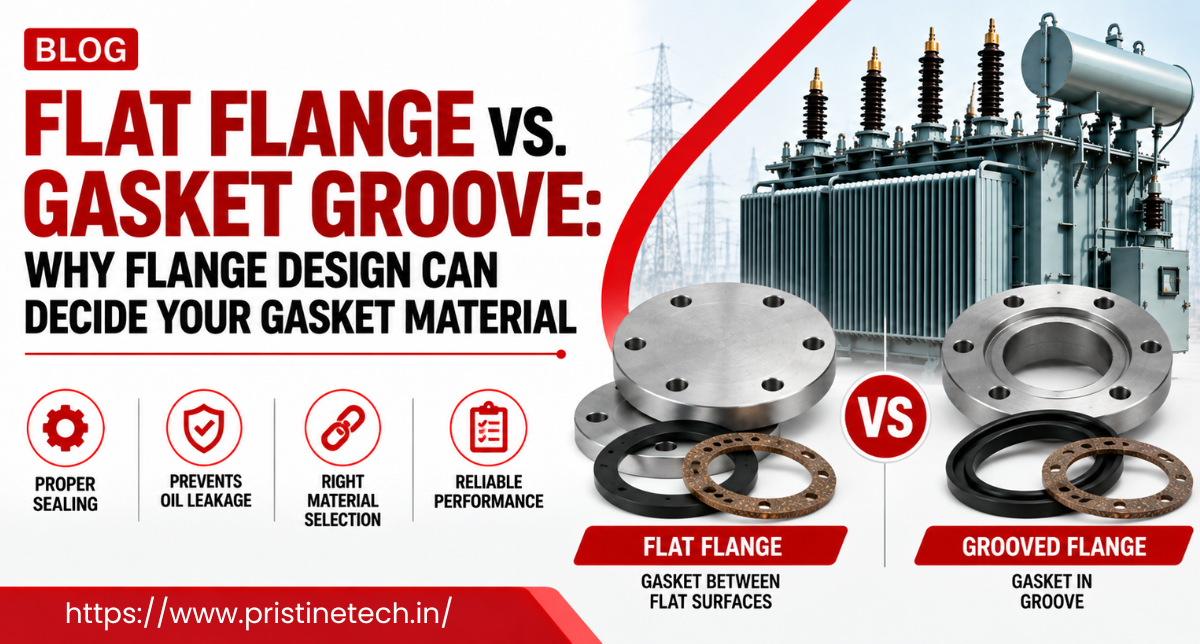
Flat Flange: Compression Needs Careful Control
In a flat flange joint, the gasket is placed between two relatively flat mating surfaces.
Because there is generally no defined groove controlling the gasket position or compression, the assembly process becomes particularly important.
Key factors include:
- Gasket thickness
- Compressibility
- Flange flatness
- Surface condition
- Bolt tightening sequence
- Compression level
Rubberised Cork is commonly used in various transformer gasket applications because of its ability to conform to minor surface irregularities.
Grooved Flange: Gasket Position and Compression
A grooved flange uses a defined recess or groove to accommodate the gasket.
This changes the way the gasket interacts with the joint.
The groove can help:
- Position the gasket correctly
- Restrict excessive lateral movement
- Control the available sealing space
- Provide more predictable gasket compression when properly designed
NBR vs Rubberised Cork: Does the Flange Change the Choice?
NBR Gaskets
NBR is an elastomer commonly considered for applications where resistance to oils and petroleum-based fluids is important.
For a grooved flange, an NBR gasket can work effectively when the groove dimensions and gasket profile are correctly matched.
Rubberised Cork Gaskets
Rubberised Cork combines cork-based material with rubber binders and is used in various sealing applications.
Its compressibility and ability to accommodate minor surface irregularities can make it suitable for certain flat flange transformer joints.
The correct choice should nevertheless be based on the complete application rather than material name alone.
Flat Flange vs Grooved Flange: Key Differences
| Feature | Flat Flange | Grooved Flange |
|---|---|---|
| Gasket positioning | Less physically restricted | Groove helps position gasket |
| Compression control | Requires careful assembly | Can be controlled by joint geometry |
| Surface irregularities | Gasket conformity can be important | Groove and profile influence sealing |
| Common material consideration | Rubberised Cork and other suitable materials | NBR and other elastomers where compatible |
| Installation | Bolt tightening is particularly important | Groove/gasket dimensional matching is important |
| Material selection | Depends on application | Depends on groove and application |
How to Choose the Right Transformer Gasket Material
Step 1: Identify the flange design
Determine whether the joint uses a flat flange, grooved flange or another sealing arrangement.
Step 2: Check gasket dimensions
Confirm the required gasket thickness, internal diameter, external diameter and profile.
Step 3: Evaluate compression
Make sure the gasket can achieve the required sealing compression without excessive deformation.
Step 4: Check transformer oil compatibility
The gasket material should be appropriate for the fluid and operating environment.
Step 5: Consider temperature
Operating and expected temperature variations should be considered when selecting the gasket material.
Step 6: Inspect the flange
Check for scratches, uneven surfaces, contamination, corrosion or other conditions that could affect sealing.
Step 7: Follow correct installation practices
Even a properly selected gasket can leak if it is incorrectly positioned or compressed unevenly.
Choosing a Transformer Gasket Is About More Than Material
NBR and Rubberised Cork should not be viewed simply as competing materials where one is universally better.
The appropriate transformer gasket material depends on the flange design, gasket geometry, compression requirements, operating environment and installation conditions.
A flat flange may place greater emphasis on gasket conformity and controlled bolt compression, while a properly designed groove can provide additional control over gasket positioning and compression.
Therefore, the flange should be considered before finalising the gasket material.
Frequently Asked Questions (FAQs)
1. What is a transformer flange gasket?
2. Is NBR suitable for transformer gaskets?
3. Is Rubberised Cork suitable for flat flanges?
Rubberised Cork can be used in various flat flange sealing applications because its compressibility can help accommodate minor surface irregularities. Suitability depends on the specific joint and operating conditions.
4. Does a grooved flange require an NBR gasket?
Not necessarily. A grooved flange does not automatically determine the gasket material. The gasket profile, groove dimensions, compression requirements and operating conditions should all be evaluated.
5. Can incorrect flange design cause transformer oil leakage?
Yes. Flange condition, joint geometry, gasket dimensions and compression can all contribute to sealing problems and oil leakage.
Explore Transformer Gasket & Sealing Solutions
Selecting the correct gasket requires looking at the complete sealing system, not just the gasket material.
For detailed information on transformer gaskets, you can also explore Transformer Gaskets.