
- By admin
- October 5, 2026
- 0 Comment
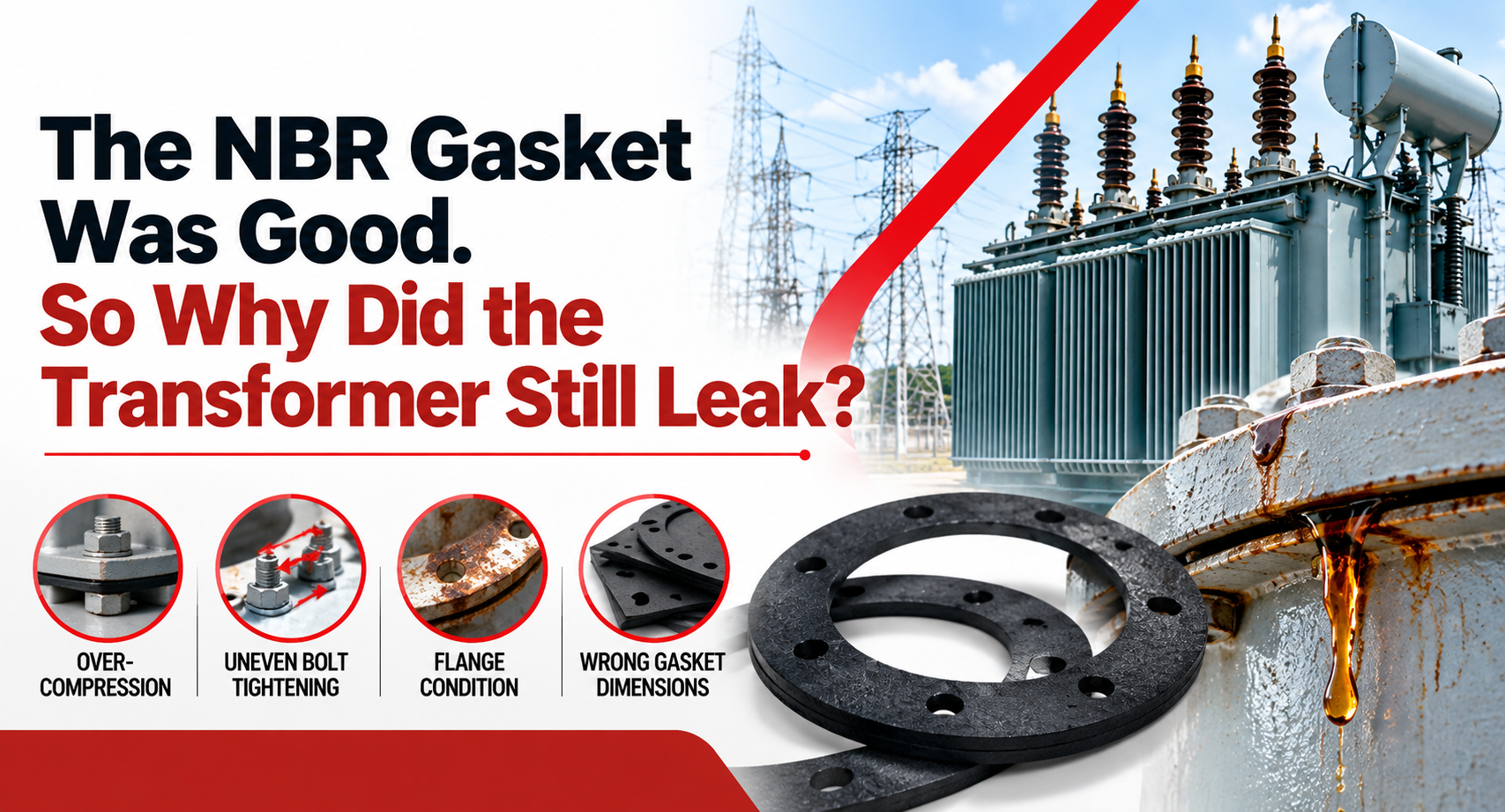
The NBR Gasket Was Good. So Why Did the Transformer Still Leak?
The transformer is leaking oil.
The first suspect is usually the gasket.
So, the maintenance team replaces the old gasket with a new NBR gasket for transformer applications. The dimensions are correct, the material is oil-resistant and the gasket appears to be good quality.
Everything looks right.
But a few weeks or months later, transformer oil leakage appears again.
So, was the NBR gasket bad?
Not necessarily.
A good NBR transformer gasket can provide reliable sealing, but the gasket is only one part of the complete sealing system. Flange condition, gasket dimensions, compression, bolt tightening and joint design can all influence sealing performance.
This is why replacing the gasket alone does not always solve a transformer leakage problem.
What Is an NBR Gasket for a Transformer?
NBR stands for Nitrile Butadiene Rubber. NBR is widely used for sealing applications where resistance to oils and petroleum-based fluids is important.
The performance of an NBR gasket for transformer applications depends not only on the rubber compound but also on factors such as:
- Gasket hardness
- Gasket thickness
- Gasket dimensions
- Operating temperature
- Transformer oil compatibility
- Flange design
- Compression
- Installation method
- Surface condition
For a deeper comparison of NBR and rubberised cork, see our guide on NBR Gasket vs. Rubber Cork Gasket for Transformers.
Why Does an NBR Gasket Leak?
If a good-quality NBR gasket has been installed and the transformer still develops an oil leak, the root cause may be somewhere else in the sealing system.
Over-Compression of the NBR Gasket
A common reaction to transformer oil leakage is:
“Tighten the bolts a little more.”
But more tightening does not automatically mean better sealing.
NBR is an elastomer. Excessive compression can change the gasket’s shape and place unnecessary stress on the sealing area.
Depending on the joint design, excessive compression can affect the gasket’s ability to maintain a stable seal.
The correct compression depends on the gasket specification and joint design.
Therefore, instead of simply increasing bolt torque, check whether the gasket is being compressed within the intended sealing range.
Uneven Bolt Tightening
Another common cause of transformer gasket leakage is uneven compression.
The gasket may then experience:
- Higher compression in one area
- Lower compression in another area
- Uneven contact pressure
- Potential leakage paths
Poor Flange Surface Condition
Before blaming the NBR gasket, inspect the mating surfaces.
Ask:
- Is the flange flat?
- Is there corrosion?
- Is old gasket material still present?
- Are there deep scratches?
- Is there paint or contamination on the sealing surface?
- Is the flange distorted?
An NBR gasket cannot compensate indefinitely for a severely damaged or improperly prepared sealing surface.
The gasket works by filling the microscopic irregularities between mating surfaces. If the flange condition prevents consistent contact, leakage can occur even when the gasket itself is manufactured correctly.
Incorrect NBR Gasket Dimensions
The following dimensions should match the joint design:
- Gasket thickness
- Inside diameter
- Outside diameter
- Width
- Bolt-hole positioning
- Cross-section or profile
- Groove dimensions, where applicable
An NBR gasket for transformer applications should not simply be selected because it looks similar to the old gasket.
NBR Gasket vs. Rubber Cork Gasket: Why Material Selection Matters
A transformer does not necessarily use one gasket material everywhere.
The choice between NBR gasket and rubberised cork gasket depends on the joint design and application.
NBR offers properties that make it suitable for many oil-contact sealing applications, while rubberised cork offers higher compressibility and can accommodate certain surface irregularities.
The important point is:
Do not select a transformer gasket based on material name alone.
Consider the complete sealing system.
Our detailed comparison, NBR Gasket vs. Rubber Cork Gasket for Transformers, explains the differences in oil resistance, compressibility, dimensional stability, joint type and cost.
How to Prevent Transformer Gasket Leakage
Check the original gasket specification
Confirm the material, thickness, dimensions and profile.
Inspect the flange
Check for corrosion, scratches, distortion, old gasket residue and other surface problems.
Confirm the flange design
Determine whether the joint is a flat flange or uses a defined gasket groove.
Select the correct gasket material
Consider NBR, rubberised cork or another suitable material according to the application.
Verify gasket dimensions
Make sure the gasket matches the drawing and joint geometry.
Follow the appropriate tightening procedure
Avoid randomly increasing bolt torque to stop leakage.
Inspect the completed joint
After installation, check the sealing area for signs of oil leakage during operation and maintenance inspections.
Think of It Like a Door Seal
You can install the best rubber seal available.
But if the door frame is bent, the hinges are misaligned and pressure is uneven, changing the rubber seal again will not solve the underlying problem.
Transformer sealing works in much the same way.
The NBR gasket is only one part of the sealing system.
The flange, gasket dimensions, compression, bolt tightening and operating conditions all work together to create a reliable seal.
So, Why Did the Transformer Still Leak?
If a transformer continues to leak after installing a new NBR gasket, don’t immediately conclude that the gasket material is defective.
Instead, investigate the complete sealing system.
Check:
Gasket → Dimensions → Flange → Compression → Bolting → Operating Conditions
Sometimes the gasket is simply the place where a larger sealing problem becomes visible.
The better question is not only:
“What is wrong with the gasket?”
It is also:
“What is happening around the gasket?”Frequently Asked Questions (FAQs)
1. Is NBR a good material for transformer gaskets?
NBR can be suitable for many transformer gasket applications because of its resistance to oils and petroleum-based fluids. However, suitability depends on the specific compound, temperature, oil, flange design, compression and operating conditions.
2. Why does an NBR gasket leak after replacement?
Leakage may result from incorrect dimensions, uneven compression, excessive compression, poor flange condition, incorrect gasket design, improper installation or unsuitable operating conditions.
3. Can over-tightening cause an NBR gasket to leak?
Excessive tightening can deform an elastomeric gasket and affect its sealing performance. The correct compression and tightening procedure should be based on the joint and gasket specification.
4. Can a damaged flange cause transformer oil leakage?
Yes. Corrosion, scratches, distortion, contamination and uneven flange surfaces can contribute to leakage even when a new gasket is installed.
5. Is NBR better than rubberised cork for transformer gaskets?
There is no universal answer. The appropriate material depends on the flange design, gasket geometry, compression requirements, oil exposure and operating conditions. NBR and rubberised cork have different mechanical characteristics and should be selected according to the application.
Conclusion
A leaking transformer does not always mean the NBR gasket is defective. Even a good-quality NBR gasket for transformer applications can fail to seal properly when compression, bolt tightening, flange condition, gasket dimensions or joint design are not correct.
For detailed information on transformer gaskets, you can also explore Transformer Gaskets.
To know more about our transformer gasket products and solutions, visit Pristine Technologies & Industries