
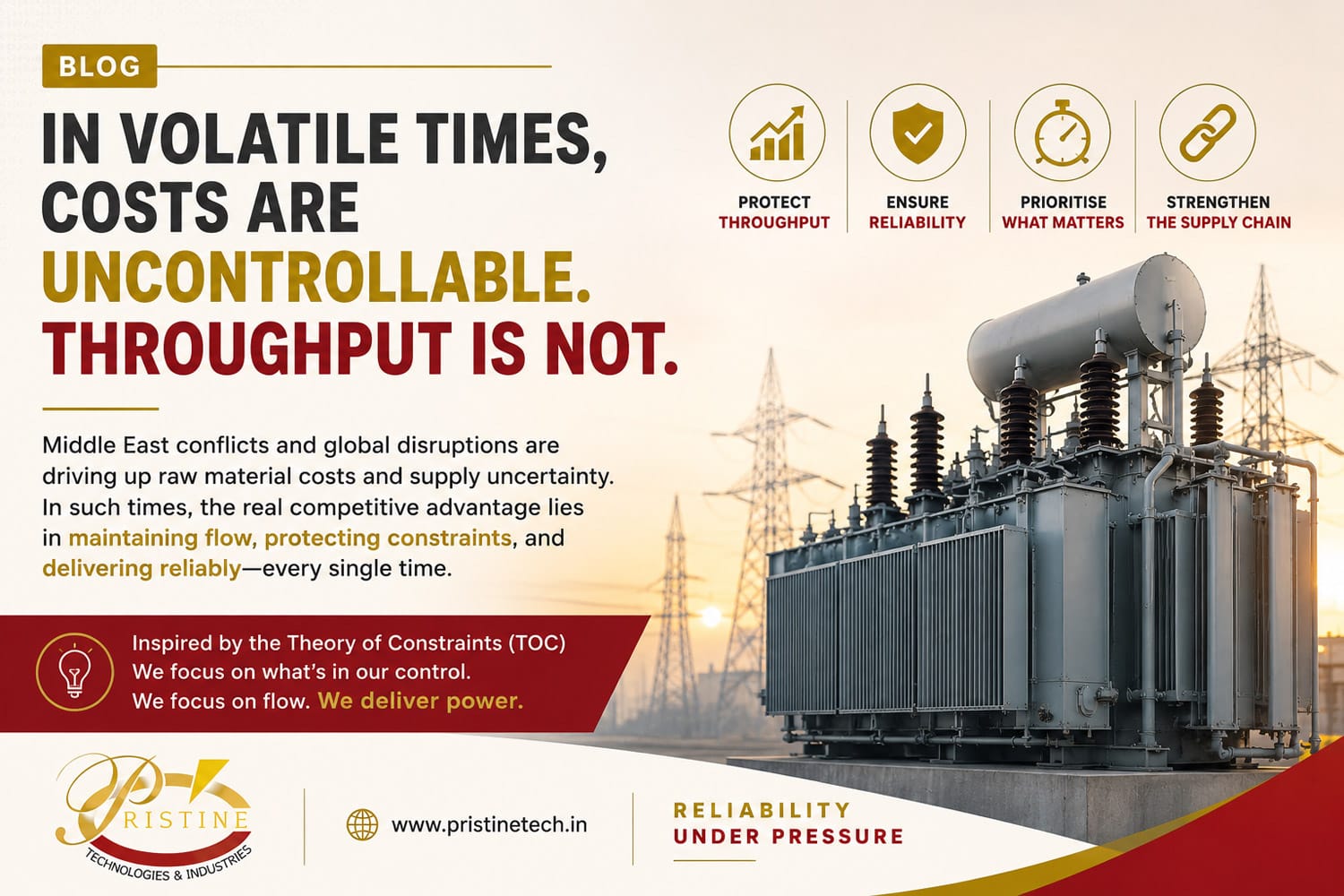
Middle East Conflict and the Transformer Industry: The Real Battle Is Reliability
The Transformer Industry’s Real Challenge Isn’t Cost – It’s Flow
The ongoing geopolitical tensions in the Middle East are sending shockwaves across global manufacturing industries. For the transformer industry, the impact is becoming increasingly visible through rising prices of transformer oil, insulation materials, rubber components, logistics disruptions, and growing uncertainty in procurement cycles.
The natural response in such situations is predictable:
- Cut costs aggressively
- Delay purchasing decisions
- Pressure suppliers for lower prices
- Reduce operational spending wherever possible
But during global disruptions, there is an uncomfortable reality many industries must face:
Most raw material costs are no longer fully within our control.
At Pristine Technologies and Industries, we believe that focusing only on cost reduction during uncertain times can often create bigger operational risks. Instead, our approach is centered on improving what we can control — operational flow, responsiveness, and throughput.
This philosophy is deeply inspired by the principles of Eliyahu M. Goldratt and the Theory of Constraints (TOC).
The Real Risk in the Transformer Supply Chain
The transformer ecosystem is highly interconnected. A delay in one seemingly small component can create cascading effects across the entire supply chain.
Consider this:
- A delayed gasket can hold up transformer assembly
- A missing insulation component can stop testing and dispatch
- Delays in rubber parts or transformer oil can impact delivery schedules
- One operational bottleneck can slow down the entire manufacturing cycle
In industries connected to power infrastructure, delays are not just commercial issues. They can impact utilities, industries, renewable energy projects, and critical infrastructure waiting for energization.
That is why the real challenge today is not simply reducing cost.
It is protecting flow.
Why Throughput Matters More During Uncertainty
Traditional cost-cutting strategies often focus on reducing procurement expenses, minimizing inventory, or postponing purchases. While these actions may appear financially prudent in the short term, they can unintentionally damage operational continuity.
During volatile periods, the more important question becomes:
What is the constraint that limits our ability to deliver consistently?
According to TOC principles, every system has a constraint — a point that determines the overall output of the system. Improving non-critical areas while ignoring the constraint creates the illusion of efficiency without improving actual performance.
At Pristine, our focus is increasingly aligned toward:
- Protecting critical operational flow
- Prioritizing high-impact transformer applications
- Ensuring availability of essential materials
- Reducing disruptions at key bottlenecks
- Improving reliability in deliveries
Because every minute lost at the constraint impacts overall throughput.
And in the transformer industry, lost throughput does not just affect production numbers — it can delay power delivery somewhere in the world.
Reliability Is Becoming the True Competitive Advantage
In stable markets, pricing often dominates purchasing decisions.
But in volatile global environments, customers begin valuing something even more important:
- Reliability under pressure
- Consistency despite uncertainty
- Predictability in execution
- Faster and dependable deliveries
Companies that can maintain operational stability during disruption build long-term trust with customers and partners.
This is why the future of transformer manufacturing will not be defined only by who offers the lowest price.
It will increasingly be defined by who can sustain flow, protect commitments, and deliver consistently when the market is under stress.
A Shift in Thinking for the Industry
The current global situation is a reminder that supply chains are no longer only procurement functions. They are strategic operational systems that require agility, visibility, and disciplined prioritization.
For transformer manufacturers and component suppliers alike, the conversation must evolve from:
“How do we cut more costs?”
to:
“How do we protect throughput and maintain delivery reliability?”
That shift in thinking can make the difference between operational disruption and operational resilience.
At Pristine Technologies and Industries, this commitment to reliability, responsiveness, and operational flow continues to guide how we work every day — especially during uncertain times.