
- By admin
- November 16, 2026
- 0 Comment
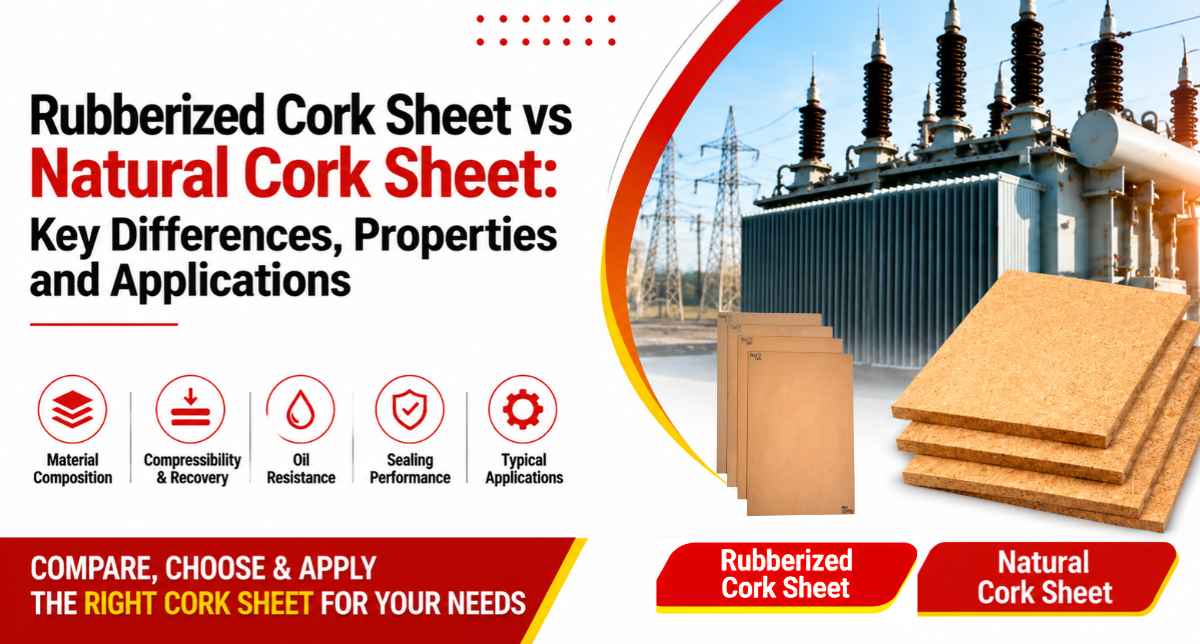
Rubberized Cork Sheet vs Natural Cork Sheet: Key Differences, Properties and Applications
Selecting the right sealing material is important for achieving reliable performance, preventing leakage and extending the service life of industrial equipment. Rubberized cork sheets and natural cork sheets are two materials used in different industrial and commercial applications.
Although both materials contain cork, their composition, flexibility, mechanical properties and performance can differ significantly.
Understanding the difference between rubberized cork sheet vs natural cork sheet helps manufacturers, engineers and procurement professionals choose the right material according to their application requirements.
What Is a Rubberized Cork Sheet?
A Rubberized cork sheet is a composite sealing material manufactured by combining natural cork granules with a rubber binder. This combination brings together the compressibility of cork and the flexibility, resilience and sealing properties of rubber.
Depending on the application, different rubber compounds can be used. NBR (Nitrile Butadiene Rubber) is commonly selected for applications that require resistance to oil and petroleum-based fluids.
Key Features of Rubberized Cork Sheets
- Excellent compressibility and recovery.
- Good flexibility and mechanical strength.
- Resistance to transformer oil and industrial fluids, depending on the rubber grade.
- Low lateral expansion under compression.
- Suitable for manufacturing customised gaskets.
- Reliable sealing performance in flat flange applications.
To understand the important properties, performance characteristics and selection criteria of rubberized cork sheets in detail, explore our guide on Key factors to consider when selecting rubberized cork sheets.
What Is a Natural Cork Sheet?
A natural cork sheet is manufactured from cork material obtained from the bark of cork oak trees. Cork contains a naturally cellular structure that gives it lightweight, compressible and insulating characteristics.
Natural cork sheets are available in different grades, densities and thicknesses. Some products are made from natural cork pieces or granules that are processed into sheets, while agglomerated cork sheets use binders to hold the cork particles together.
Natural cork is used in applications such as insulation, cushioning, flooring, acoustic panels, decorative products and certain general-purpose sealing applications.
Key Features of Natural Cork Sheets
- Lightweight natural material.
- Naturally compressible cellular structure.
- Good thermal and acoustic insulation properties.
- Suitable for cushioning and vibration absorption.
- Renewable raw material.
- Available in different grades and thicknesses.
Applications of Rubberized Cork Sheets
Power and Distribution Transformers
Rubberized cork gaskets are used in transformer tank covers, flange connections and other sealing locations to help prevent transformer oil leakage.
Industrial Machinery
Industrial equipment often requires gasket materials that can accommodate surface irregularities and maintain sealing under compression.
Oil-Filled Equipment
NBR-based rubberized cork sheets are suitable for selected oil-sealing applications because of their resistance to compatible oils and fluids.
Electrical Equipment
Rubberized cork components are used in various electrical equipment and transformer assemblies where sealing performance is required.
Applications of Natural Cork Sheets
Natural cork sheets are used in applications that benefit from their lightweight structure and natural insulating properties.
Common applications include:
- Thermal insulation products.
- Acoustic insulation panels.
- Flooring and underlay materials.
- Cushioning and protective pads.
- Decorative and interior applications.
- Selected general-purpose gasket applications.
Comparison Table: Rubberized Cork Sheet vs Natural Cork Sheet
| Parameter | Rubberized Cork Sheet | Natural Cork Sheet |
|---|---|---|
| Composition | Cork granules with rubber binder | Natural cork or agglomerated cork |
| Flexibility | Enhanced by rubber binder | Depends on cork grade |
| Compressibility | Designed for gasket sealing | Naturally compressible |
| Recovery | Engineered for compression recovery | Depends on density and grade |
| Oil Resistance | Good in suitable NBR grades | Requires application-specific verification |
| Sealing Performance | Suitable for industrial flat flange gaskets | Suitable for selected general-purpose sealing |
| Insulation | Depends on composite formulation | Naturally useful for thermal and acoustic insulation |
| Common Applications | Transformers, industrial gaskets and oil sealing | Flooring, insulation, cushioning and general-purpose applications |
Why Choose Pristine Technologies & Industries for Rubberized Cork Sheets?
Pristine Technologies & Industries manufactures rubberized cork sheets and components for power transformers, distribution transformers and industrial sealing applications.
Key product specifications include:
- Rubber polymer: Acrylonitrile-Butadiene Rubber (NBR).
- Cork grain size: 0.5 mm to 1.0 mm diameter.
- Standard sheet size: 1000 mm × 1000 mm and 900 mm × 600 mm.
- Thickness range: 2 mm to 25 mm.
- Hardness: 70 ± 5 IRHD.
- Compressibility: 25–35% at 2800 kPa.
- Recovery: Minimum 80%.
Frequently Asked Questions (FAQs)
1. What is the main difference between rubberized cork and natural cork sheets?
Rubberized cork sheets combine cork granules with rubber binders for industrial sealing, while natural cork sheets primarily use natural cork for insulation, cushioning and general-purpose applications.
2. Is rubberized cork better than natural cork for gaskets?
For suitable industrial flat-flange applications, rubberized cork generally offers more controlled sealing and compression characteristics. Material selection depends on operating conditions.
3. Are rubberized cork sheets resistant to transformer oil?
NBR-based rubberized cork sheets offer good resistance to compatible transformer oils and are commonly used in transformer gasket applications.
4. Where are natural cork sheets commonly used?
Natural cork sheets are used in flooring, thermal insulation, acoustic panels, cushioning and selected general-purpose sealing applications.
5. Which rubberized cork sheet is suitable for transformers?
NBR-based rubberized cork sheets are commonly used for transformer applications because of their compressibility, recovery and transformer oil resistance.
Conclusion
Both rubberized cork sheets and natural cork sheets have their own advantages and applications. Natural cork is suitable for various insulation, cushioning and general-purpose applications, while rubberized cork sheets are engineered for industrial sealing requirements.
For transformer manufacturers and industrial equipment suppliers, selecting the right gasket material is essential for reducing leakage risks, improving sealing performance and supporting equipment reliability.
Contact Pristine Technologies & Industries to discuss your rubberized cork sheet requirements and customised gasket solutions.